


I’ve loved reading the responses to my democratization post last week – thank you. My basic belief is that most mental health care can be preventative, and that we can care for ourselves with regular practice on our own and in community. These communities happen to be multiplying very quickly right now, and I want to help them multiply faster. To that end, here’s a free kit on starting your own DIY meditation group:
But how do you invite people into a spirituality-adjacent group without sounding…creepy?
When I first started meditating with friends and family, I would just say “Hey, I’m doing this ‘cause I found meditation helpful in this way (insert personal experience). Join me if you want.”
Period.
I never try to be evangelical. That puts out the wrong vibes. Plus I have no idea what somebody needs, or what practice will be most supportive for them.
In fact, if I find myself chatting with someone who’s both struggling and interested in practice, I rarely start with meditation. Instead, I try to figure out if they already have a practice, like running or knitting or gardening, something they do that’s a centre of focus and stability and even insight for them. I see if there’s a way of making that practice more deliberate. And then I widen the lens to position that practice within a larger, more transformational framework.
What do I mean by that?
Here’s my quick take on three deeply beneficial tiers of practice, each sort of blending and overlapping with the others. Many of these practices can be done with a friend or in a small group, which can amplify their effect and help us take them more seriously. (And to be clear, nothing I discuss below means there may not be other common-sense things people can do to help themselves, like sleep and nutrition and exercise and so on.)
Tier 1 - Concentration Practices
These are things that we do where we get absorbed in the action, lose track of time, and ultimately emerge refreshed, like we got a substantive break from our worries. This is not exotic intel. Many of us already do some kind of flow-like activity, such as art, sport, music, dance, yoga, nature immersion, spending time with friends, etc. The best of them use our whole attention and our whole body, which is why we can’t get the same benefits from sitting fixated in front of a computer screen or (unfortunately for me) watching ridiculous but oddly cathartic Marvel films.
I’ve written more about this kind of high-focus practice here. The main skill is concentration. Meditative concentration practices can get very settling indeed, since you are not focusing on anything stimulating; rather you’re going deeper and deeper into one-pointed silence and space.
Tier 2 - Insight Practices
You can do any of the activities above, and if you are intentional and regular about it, they will make a difference in your life. But will they get you out of a rut? Will they give you perspective or insight about your relationships, your work, the way you yourself are contributing to your challenges? (After all, a great deal of our fuckery is an inside job.)
They might. If we can get the thinking mind quiet, insights do come. They come out of the silence.
And… we can also be more direct about cultivating insight. Through a journaling practice, through intentional check-ins with a perceptive friend or therapist or psychiatrist. Through ceremony, through prayer, through dream work, through divination practices, and somatic practices, and breath practices. The main skill here is clarity.
Insight practices on their own – the constant problem-solving of our own lives – can get a bit wiggy and solipsistic if they’re not balanced with the first or third kinds of practice. In mindfulness meditation, the layers of insight keep going, from our patterns of thinking, feeling and reacting all the way down to the constructed nature of identity itself. There are plenty of descriptions of that in Buddhist and other mystical writing. It’s bonkers and paradigm-shaking.
Is it necessary for everyone to explore this “constructed nature of identity”?
This is where I probably have different ideas than most meditation teachers, certainly most Buddhist teachers. While I think everyone can benefit from getting insight into their patterns, I’ve found from years of teaching insight that the fine-grained deconstruction that mindfulness practice points to isn’t very accessible (or even interesting) to most people. Nor have I found nondual “aware of awareness” type practices to be particularly relatable (or comprehensible) to the average practitioner, as much as they have meant to me on my path. This may be a deficiency in my own teaching, but it’s what I’ve observed.
What I’m trying to say is if these two styles of practice mean nothing to you, that’s fine. I don’t think you need them. Because there’s a more important category of practice, one that gets into the same deep territory as above, but is more democratically available.
Tier 3 – Surrender and Service Practices
These are the practices of getting over yourself. Of surrendering your small clanking willful agenda and getting humble enough to listen to what life is showing you.
This is the heart of spiritual practice, whether or not you call it that. It can happen in as many ways as there are humans to inhabit those ways, from ecology to math, poetry to activism. In fact, many of the practices from the other two tiers fit naturally here, if they’re engaged in with the right curiosity and devotion and humility (dialing these up this is one way I help people boost their practice). Attention here isn’t on yourself; it’s on the world, and what’s beyond the world, beyond our ability to capture or neatly articulate. It’s on the lessons that arrive moment by moment in our exact lives. It’s on being in relationship with life.
The main skill here is equanimity, a kind of radical availability and surrender to the moment. And the more you weave in deliberate caring and appreciation practices, the more what catches you in that moment is your best human self.
In karma yoga practice, it begins with service and works backwards, showing you where your small self resists. Others find it the other way around: they begin with letting go, and find what then emerges naturally is both gratitude and a desire to give back. Not to be idealistic about it, but that is a sequence I’ve seen again and again. Often it means helping someone with something we ourselves have gone through, turning our problem into someone else’s solution.
To come back to the original point of this post… when someone comes to me who is struggling, I sometimes recommend meditation. If they’re interested in it.
And… I’m also curious about what other practices they do. If they enjoy some activity that fits under a concentration practice, then I recommend they get more intentional about making that a regular thing. I also check to see if they’re getting any feedback about their situation; we talk about what might be a good fit for them there, including – if necessary – seeking professional help. Finally, I get curious about where in their life they feel connected to something larger than themselves, and whether they can hold that direction. There is so much variation and creativity in what that can look like. Whatever practice(s) we discover here, they often become the source of both our greatest healing, and our greatest capacity.
What all this means is, once you understand how these different classes of practice work, you can then build your own from the raw material of your existing proclivities and interests. One reason I love meditation is that it’s both very simple, and it touches on all three tiers. In today’s guided practice, we explore exactly this, in a non-hierarchical and relaxed kind of way.
Thank you for your attention, and for being part of this community.
Love,
Jeff.

A few quick notes—
The next Do Nothing Project (DNP) live meditation is Sunday, June 14 at 8pm EDT. Link here. The DNP is for paid subscribers three times a month, and free for everyone the first Sunday of the month. If the cost of a subscription is not accessible to you, full scholarships are available at info@jeffwarren.org. Replays are archived on Monday morning.
New to Home Base? We have over 75 free guided meditations in our audio library, over 60 extended meditations, over 365 meditations on YouTube, and a growing number of community practice videos. New writing, new audio meditations, and new live community gatherings happen every week.
Home Base is best experienced on a web browser (laptop or mobile), NOT the Substack app. The app is great for finding new authors who have much to say, and, like any social media platform, it will suck out your eyeballs and, eventually, your brain. Plus the more pubs you subscribe to (they automatically offer these after you sign up), the more Substack will flood your inbox. To manage Substack emails and notifications, read this.
Did you find me on Calm or Happier? While the meditations I made for the apps live on in perpetuity, I no longer record new meditations for them. My latest work happens here; becoming a paid subscriber is the best way to support that work. If you found this meditation and post helpful, but becoming a paid subscriber isn’t an option, you can also …
Many thanks!

Meditation for Neurodivergent Minds
June 17, 2026 at 2pm ET
Live Podcast
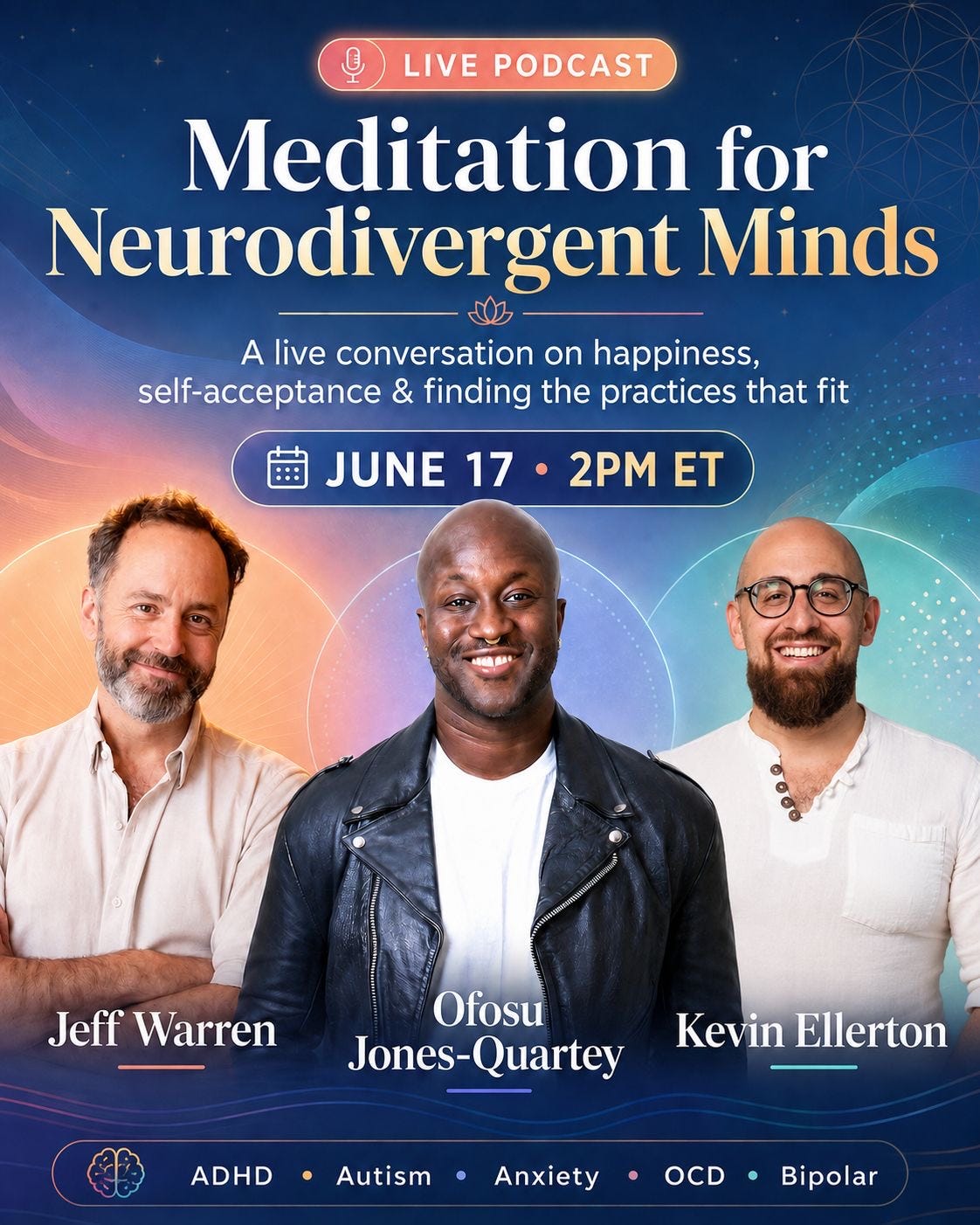
Next Tuesday I’m doing a live conversation with my friend Ofosu Jones-Quartey (Born I) and Kevin Ellerton, the publisher of Meditation Magazine, all about how neuro-sparkly humans can make practice work for them.


