


Click above for this week’s guided meditation
Hey friends,
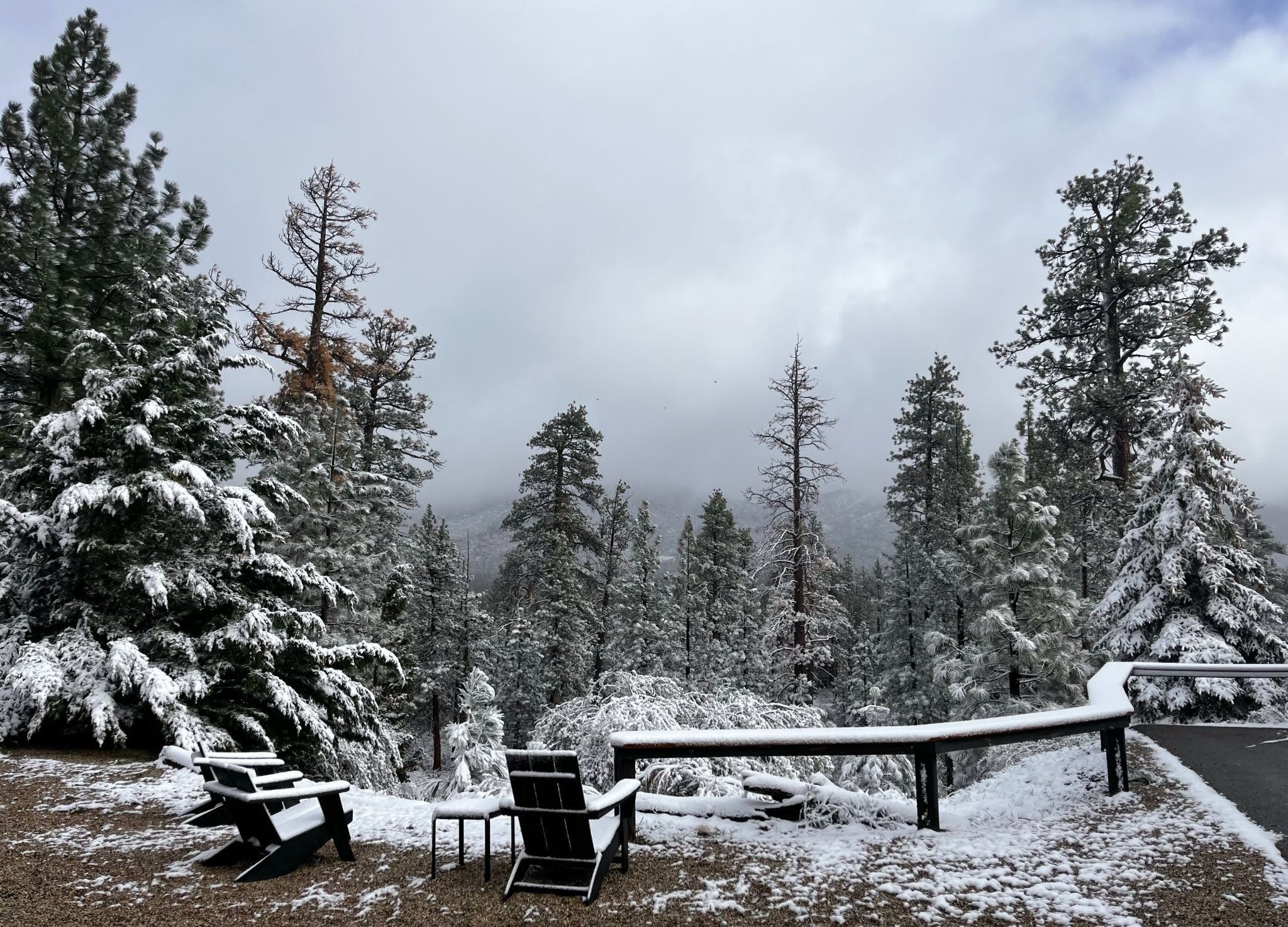
Do you like my clickbait title? Kind of serious about it. I just got back from a four-day meditation retreat at Big Bear Retreat Center east of Los Angeles — not teaching, but as a grateful participant. It’s a beautiful alpine spot with tall trees that smelled of butterscotch and were called “Jeffrey pines” (I’m a dork for these ham-handed synchronicities) and even an icing of snow on the final night. With the craziness of my parenting life, I’m only able to get to a retreat once a year, and thanks to my generous partner, Sarah, this was my window. It always rejuvenates my practice. Since returning, I’ve definitely been calmer and less reactive with my kids. We’ll see how long it lasts!
OK, let’s get to the teaching, and then I’ll guide a practice around it.
The retreat was called “Coming Home to Our Senses,” with teacher cadre Trudy Goodman, Gullu Singh, Lienchi Tran and Gabrielle Hammond. It was a Buddhist vipassana retreat, which means the emphasis was on a mindfulness-style continuous noticing of present-moment sensory experience. Instead of just focusing on the breath or a sound or whatever you might ordinarily choose for a home base, you maintain a kind of halo of awareness around the whole experience. By that I mean you aren’t just aware of the breath, you are aware that you’re aware of the breath. So there’s a kind of metacognition operating. What’s more, you’re also training yourself to become aware of the various subtle and not-so-subtle flavors of interference that, as you sit, or walk, or eat, or do anything, inevitably come between you and what you’re trying to be aware of.
In Buddhist-speak, participants were guided to tune into craving, or aversion, or delusion: the “three poisons” of Buddhism, said to be at the root of much of our human suffering and unskillful behavior. So “craving” is a kind of shorthand for our grabby, greedy attachments, our urges to lock down life’s good stuff. “Aversion” is the opposite: all the subtle and not-so-subtle ways we push away or recoil from things we don’t like, states of anger and hatred and ill-will and the urge to destroy. Not that you need to be perfect, but this stuff does very obviously mess with your sanity. And that leads directly to “delusion”: ignorance or confusion about the deep role craving and aversion play in our stresses and agonies, and – deeper still – not realizing that all this suffering is based on a kind of optical illusion of our separateness that doesn’t hold up under prolonged meditative scrutiny.
Whoops, veered into religious territory there! Sorry.
Funny thing about that. Faith is a central part of Buddhism, just like it is in any belief system. In this case, to discover the power of awareness, to begin to trust that there is something to learn here about craving and aversion – well, it helps to have a little faith. Meditation proponents often say “look for yourself and find out,” as though it were a purely empirical science. That’s not wrong. But it’s also not the full picture. It helps to have confidence first, before you look. In fact, the more confident you are that there’s something to discover, the more likely you’ll be to discover it. We’re not dealing with objective reality (whatever that is). We’re dealing with the mind, and the mind is what opens or closes us to experience in the first place!
In Buddhism, this confidence is called “Right View.” It’s one of the necessary steps for all this to be effective. It’s trusting that just being aware has its own kind of power, even if the effects are subtle at first. It’s trusting that if you notice your craving or aversion in real time, the intensity of your stresses will diminish. As this happens, confidence in the view grows, reinforcing and deepening the benefits, creating even more motivation, and so on – exactly the kind of positive feedback loop a successful practice depends on.
Here’s what often happens for me. I’ll guide a practice after, so you can see how it goes down for you.
1. I start all spaced out or agitated or whatever and I choose the breath to pay attention to and, over time, my mind gets a little more settled. That can take a while! You see why it’s helpful to go on multiple-day retreats. Fortunately, the practice is scalable, so even a bit of settling can lead to a bit of insight.
2. I experience the sudden relief of realizing all I need to do (forever) is just be aware of what’s here. Breathing and knowing I’m breathing. Daydreaming and knowing I’m daydreaming. Coming back. Tiring and knowing I’m tired. I don’t have to change anything. Just slow down and notice what exact thing is here. In walking meditation, I take a step and notice my foot on the ground and I’m with that vertical experience. Meditating on the breath, I notice the soft quality of the breath. And then…
3. Suddenly, I’m not fully doing that anymore. Some subtle craving or aversion has also entered my experience. I’ve become a little bit bored and I kind of want to daydream or think about something to escape that boredom. Or I’m walking and I start to half-fixate on the random crack in the pavement five steps ahead, where I’m planning to turn around. Whatever it is. Something comes between me and the moment being just fine, all on its own.
4. And…I notice it. I notice my little clutch of wanting. Or my disdainful push of aversion. Or some way I’m getting ahead of myself and I want to be getting ahead of myself. I don’t try to change it. I just notice, and go, “Oh, interesting.” And in the noticing, the push/pull of it often drops away. And then I’m more fully back in the present, and I realize there was never a problem in the first place. It was all in my mind. I still might be uncomfortable, or bored, but now it’s not a problem. It’s just part of what’s happening.
You can have this insight in the most profound way, and in the most ordinary way. A growing realization can begin to dawn: “How much of my time has been spent being owned by these endless cravings and aversions?’ It’s like waking up out of a dream.
It’s enormously powerful in the moment, and it’s enormously powerful as you begin to apply the insight looking backwards over your life.
For myself, I think about how I get so fixated on a particular outcome, especially when parenting. I can drop the fixation and still get my kids to school on time, except now with a lot less screaming. Or I notice my aversion to something my partner is doing. But it’s not my partner‘s fault. Nothing is anyone’s fault, at least not in our typical Western individualistic blame-assigning way. Because nobody is doing anything. It’s all just causes and conditions playing out. Those causes and conditions can change, but in this moment, things are how they are, because … that’s how they are!
So I just accept it and start again from there. And everything is so much easier and more sane and more pleasant from this place. And, to reassure you diehard Type-A busybodies (of which I am one), this also seems to be a more effective place from which to get concrete stuff done.
None of this is new, of course. You’ve read it or thought about it a hundred times. But that doesn’t mean it isn’t still an incredibly powerful teaching!
Do the practice for yourself, and let me know in the comments how you like it. Next week, we’ll explore how to use the practice in the context of strong emotions, and how that all goes down.
Appreciate you, friends. Thanks for letting me get all Buddhist-y on you. And thank you to my excellent retreat teachers.
Jeff

A few quick notes—
The next Do Nothing Project (DNP) is Sunday, May 3 at 8pm EDT. Link here. The first DNP of every month is free for everyone.
New to Home Base? We have over 75 free guided meditations in our audio library, over 60 extended meditations, over 365 meditations on YouTube, and a growing number of community practice videos. New writing, new audio meditations, and new DNP live community practice sessions happen every week.
Did you find me on Calm or Happier? While the meditations I recorded for these apps live on in perpetuity, I no longer record new meditations for them. My latest work happens here; becoming a paid subscriber is the best way to support that work. If you found this meditation and post helpful, but becoming a paid subscriber isn’t an option, you can also …
Many thanks!

Meditate, Relate and Creatively Self-Regulate
July 16-19, 2026
Art of Living North Carolina

This retreat is about not being the only weirdo in the room. Everyone here will be the weirdo in the room! Including your two teachers, Jeff Warren and Ofosu Jones-Quartey (Born I). What unifies us is the sense that our brains are wired differently, and those differences have brought both real challenges and real creative opportunities.
I was at a retreat here in the woods of Colorado a couple of years ago and the retreat leader said “Go smell the pines. They smell like butterscotch.”
Doubting her, I slowly followed everyone outside, found a friendly looking tree and leaned in to smell it with all the grace of a middle schooler figuring out their first kiss.
Butterscotch. So much butterscotch. Me and that tree stayed close the rest of the weekend and it was the most present I was the entire time.
This piece and the guided practice reminded me that real presence is totally possible, and reminded me how I can get there.
Also, I think that tree and I may be common law married.
Jeff, I entered a very emotional space while sitting with this meditation, and I'm still a bit shaken as I write this. I have chronic shoulder pain which I generally manage to ignore, but when it flares it demands my attention. So tonight’s meditation became about sitting with that physical pain.
Most often, when I'm meditating and something troubling seeps in, I try to look for the quiet space underneath it, an approach that you have suggested elsewhere. It eases the unpleasant sensation by reminding me that I am more than the physical or emotional pain.
Tonight as I listened to this meditation, the suggestion was to be aware of what I wanted to push away and try to accept it, to sit with it as it is. Sitting with it brought me to tears. But after a few minutes, acceptance also brought some relief from intense physical pain.